
Sub-Total: $0.00
Post
Chicago Charter Boat Workshop: Key Takeaways for Success!

05/01/2025 | | Boat Safe Chicago, Boat Safety, Boat Training, Charters, Chicago Fire Department, Chicago Harbor Safety, Water Safety
On Tuesday, April 22, the Columbia Yacht Club in downtown Chicago hosted a fantastic workshop about the charter boat scene in our vibrant city. This engaging three-hour boat workshop provided a wealth of information about the charter vessel industry in Chicago.
This helpful gathering was made possible through the collaborative efforts of the Chicago Harbor Safety Committee, the International Ship Masters’ Association, Chicago Lodge 3, and the Association of Rental Boat Owners & Operators (ARBOO) – a big thank you to them!
We started with a warm welcome from John McDermott of the Chicago Harbor Safety Committee. It’s always great to begin with a friendly face!
Next, we heard from Gabe Argumedo, the president of Ship Masters’ Lodge #3. With its impressive 130-year history, ISMA dedicates itself to education, community support, advocacy, and upholding its rich traditions.
Many of us remember President Argumedo’s last introduction in February when he bravely welcomed everyone to the Shipmasters’ Industry Day. That event was a real testament to the maritime community spirit, despite a last-minute setback from the government administration that prevented the main speaker, the United States Coast Guard (USCG), from participating. Even though the Shipmasters offered refunds when their main speakers had to withdraw, it was heartwarming to see a full house, and the event was a resounding success!
Disclosure: Boat Safe Chicago is a proud Shipmaster’s Industry Day sponsor.
Following Gabe, Chris Brooks from ARBOO took the stage to emphasize the crucial importance of staying up to date with regulations. He warmly encouraged everyone involved in the industry to consider joining ARBOO. It’s always good to have strong associations working together!
Then, we had the pleasure of hearing from Marine Officer Mark Walsh of the Chicago Police Department’s Marine Unit. With an impressive 24 seasons under his belt, Officer Walsh shared that his dedicated unit now comprises 32 officers, six sergeants, and support staff. And here’s a cool tidbit: did you know the Chicago Police Marine Unit has been working full-time since the 1960s? That’s a lot of history on our waterways!
Our Chicago Fire Department superhero, Chief Jason Lach, spoke next. He emphasized the vital importance of using channel 16 for emergency communication, with 911 as a reliable backup. Chief Lach also provided us with an overview of the Chicago Fire Department’s extensive resources, including its mass casualty unit, aerial reconnaissance capabilities, and the department’s brave rescue swimmers and divers. It’s reassuring to know its marine unit covers a vast 28 miles of our lakefront and has responded to emergencies over 22 miles offshore!
The next speaker, who did not provide his name, represented Chicago Harbors and Westrec. In a stern tone and straightforward manner, he discussed the “habits of compliance.” He reminded us that last year’s focus was on education, covering critical areas like:
- Rules of Conduct
- United States Coast Guard requirements
- State of Illinois procedures
He then clearly stated that this year’s emphasis would shift to enforcement and the potential revocation of Chicago Harbor charter permits for anyone not adhering to city, state, or federal regulations. It’s a good reminder to ensure we operate safely and within the rules.
Following this, we welcomed Shari Friedman, an attorney at Marwedel, Minichello & Reeb, P.C. Ms. Friedman provided valuable insights into the document requirements for obtaining a Chicago Harbor charter permit. These include:
- A sample charter agreement that clearly outlines the following: A. How the boat owner transfers operational control of the vessel to the charterer B. The charterer’s right to choose a captain. C. A description of the charterer’s responsibilities for the vessel.
- Waivers: These are essential documents that every person on the boat needs to sign before setting off. A clear process for how and when these waivers are executed is critical.
- Insurance: Ms. Friedman strongly recommended that everyone thoroughly understand their insurance policy, including who is covered and any exclusions. It pays to know the details!
Next, Nick Costa from the Illinois Department of Natural Resources shared important information about reporting accidents and property damage. He specified that reports are necessary for:
- Property damage exceeding $2000.
- Any injuries.
- Any fatalities.
He also reminded everyone about the requirement for a clearly displayed state rental license on the boat. Nick suggested keeping a binder onboard with all essential boat information, including the rental agreement – a great organization tip!
What are some things the DNR always checks when they board a boat?
- Navigation lights
- Registration
- An Illinois DNR sticker decal properly affixed to the vessel
Following Nick, we heard from Anthony Lewandowski, a criminal investigator with the United States Coast Guard Investigative Service. He introduced the CGIS Tips program and shared how to report any suspicious activity.
Mr. Lewandowski emphasized the importance of reporting anything that seems unusual, stating that you can provide as much or as little information as you feel comfortable with. He also noted the seriousness of CGIS involvement, stating, “If our agency is involved—it’s serious.”
Mr. Lewandowski highlighted the strong partnership between the United States Coast Guard and the Chicago Harbor Safety Committee, noting the extensive guidelines available on the committee’s website, which include valuable information such as the federal guidelines for recreational boat owners. He strongly suggested adding the Chicago Harbor Safety Committee website to your bookmarks – a handy resource!
“The Chicago Harbor Safety Committee works with all the government agencies,” Mr. Lewandowski explained, encouraging everyone to bring any concerns to their quarterly safety meetings.
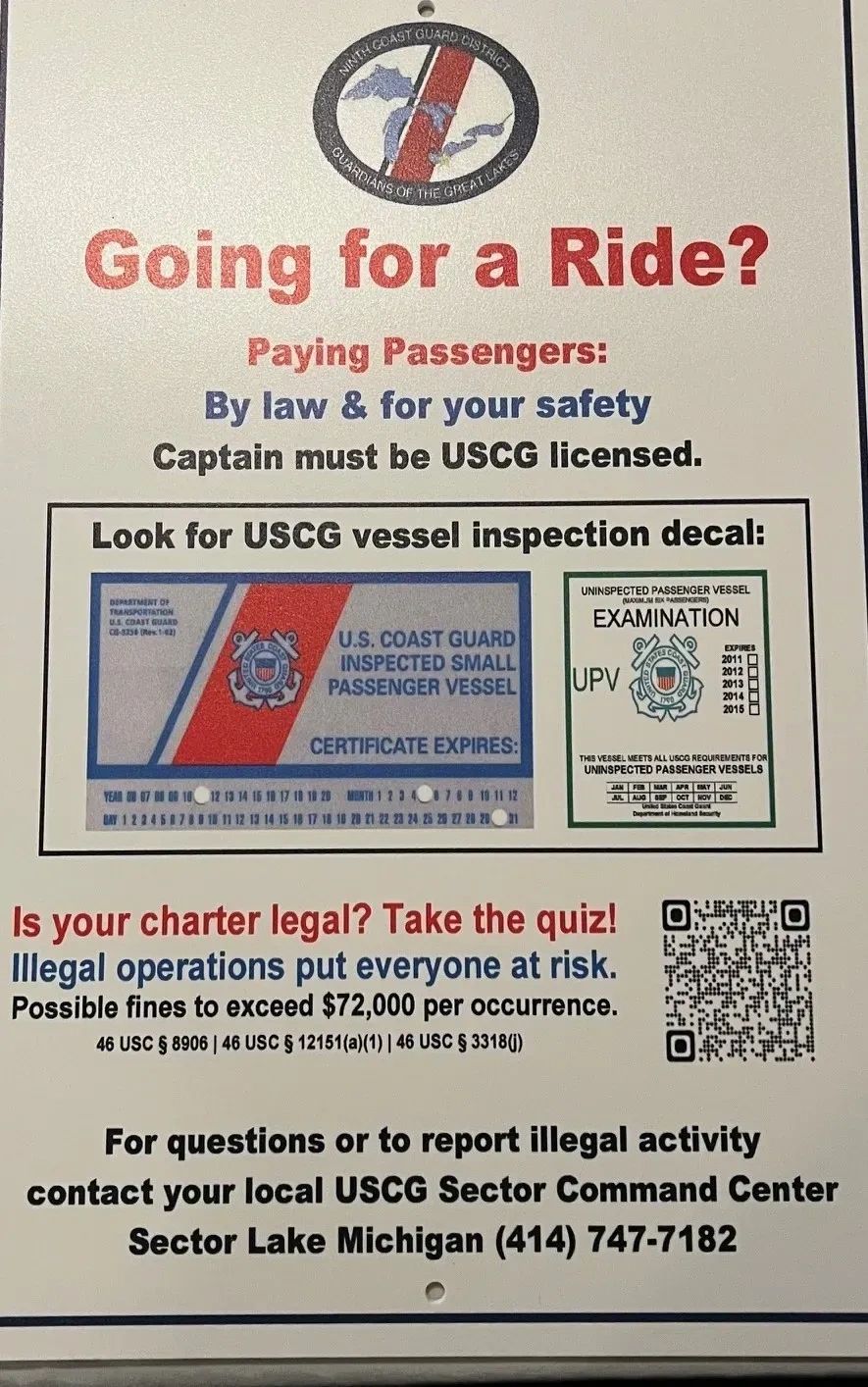
Next up was Glen Lovelace, a 28-year veteran of the Coast Guard and a Marine Maritime Warrant Officer. He spoke about the “Research before Renting” program, stressing the importance for vessel owners to understand how their vessel is classified:
- Recreational vessel
- Passenger vessel (PV)
- Small passenger vessel (SPV)
- Uninspected passenger vessel (UPV)
If you have any questions about which regulations apply to your specific situation, the USCG‘s Inspections Division is a helpful resource. You can reach them at 630-986-2155.
One key point Officer Lovelace emphasized was that “The Coast Guard does not need permission to board your vessel.” Unlike on land, no warrant is required; therefore, it is crucial to inform charterers and/or passengers that they should cooperate fully with any Coast Guard requests.
Officer Lovelace also clarified that the old “7 elements of bareboat charter” are no longer relevant. He highlighted some important points regarding recreational charter crew:
- Crew members must NOT pay to be on the boat; they must receive pay for their service.
- The master (captain) or the charterer can pay the crew.
- The boat owner cannot pay the crew.
Officer Lovelace further explained that while a recreational boat owner can have a crew member accompany the boat, that crew member must be paid by the captain or the charterer and must only follow the charterer’s instructions without reporting back to the boat owner during the charter.
He also reiterated that while a boat owner can provide a list of recommended captains to a charterer, they cannot require the charterer to hire someone from that list. He suggested that everyone check out “A Boater’s Guide to Federal Requirements for Recreational Boats.”
Officer Lovelace then discussed the drug testing requirements for small passenger vessels, as outlined in 46 CFR Part 16 of the federal code.
During Officer Lovelace’s presentation, we were joined by a special guest, Mike Herbert from U.S. Customs and Border Protection, who discussed the Jones Act and Coastwide Trade Laws. These laws, which are detailed and beyond the scope of this summary, generally restrict the transportation of passengers and merchandise between points in the United States to vessels that are:
- Built in the United States.
- Documented under U.S. law.
- Owned by citizens of the United States.
If you own a foreign-built vessel, it is essential to understand these coastwise trade laws and determine if you need a MARAD waiver for foreign vessels owned by a U.S. citizen.
Finally, the session concluded with a valuable Q&A session with the audience. One charter boat owner raised a common concern about not being able to select the captain, as this prevents vetting qualified individuals who are familiar with her boat and ensure passenger safety. Officer Lovelace explained that the USCG enforces government laws, which recreational boat owners must follow. He offered a potential solution for this owner: pursuing the higher standard of becoming an inspected small passenger vessel, which would allow her to select her own captain and crew.
Another audience member mentioned that some charter insurance companies request to see the owner’s list of vetted captains, which is provided to the charterer. Officer Lovelace described this as insurance companies potentially “pigeon-holing you into becoming an inspected small passenger vessel,” reiterating that the charterer must be free to choose their captain and crew.
Overall, this meeting was packed with essential information and a worthwhile investment of time. Plus, being hosted in the wonderful atmosphere of the Columbia Yacht Club made it an even more enjoyable experience!
CHEERS to a safe 2025 boating season!