
Sub-Total: $0.00
Post
Highlights: The 2026 Bareboat Workshop at Columbia Yacht Club

The Chicago lakefront is more than just a scenic vista; as Bill Endsley, Chicago Harbors Assistant Controller, noted during this year’s Bareboat Workshop, “It is the largest and best municipal harbor system on the planet.” Protecting that asset requires a community of informed, professional mariners.
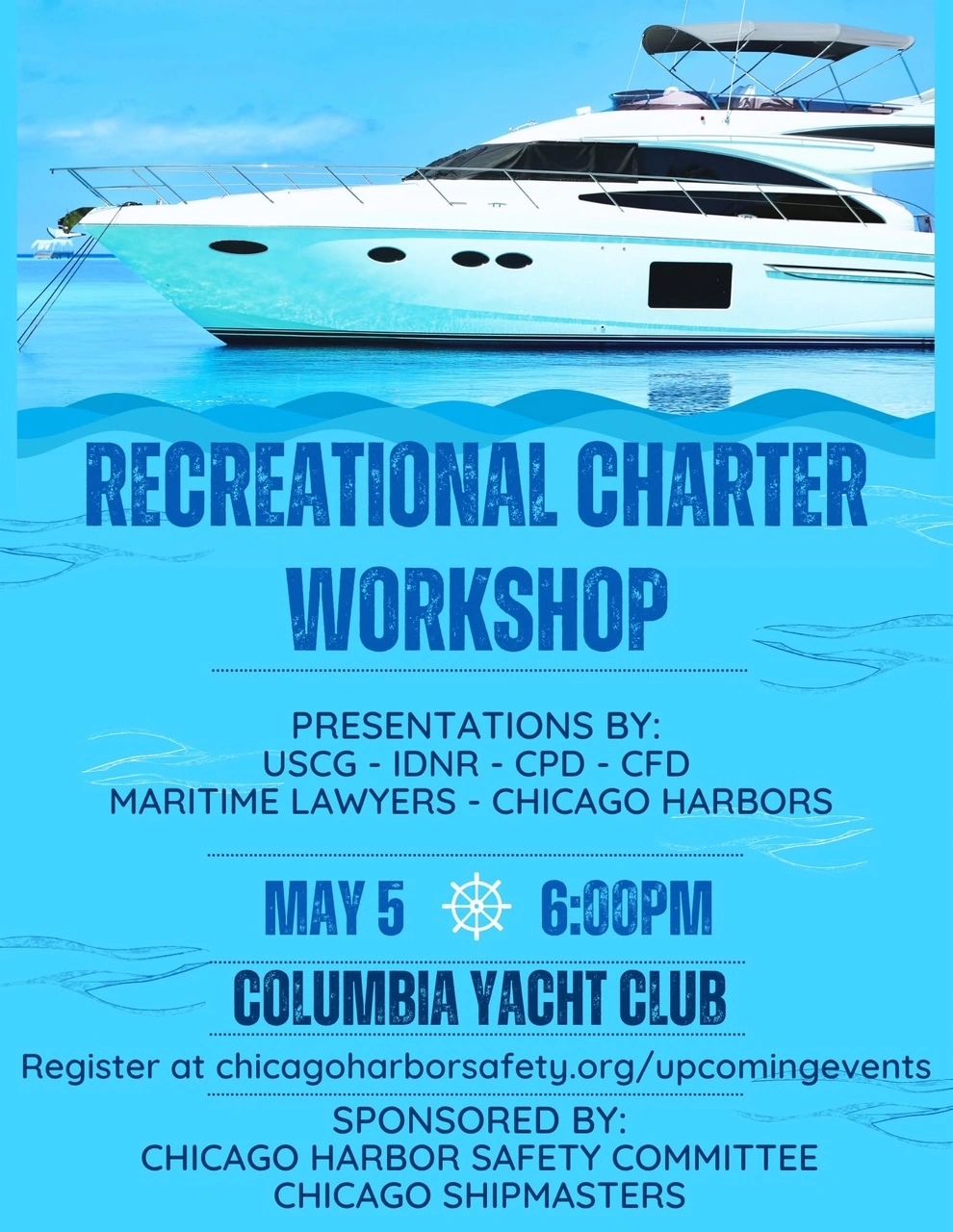
The Chicago Harbor Safety Committee and the Chicago Shipmasters hosted their annual Bareboat Workshop at the stunning Columbia Yacht Club on Tuesday, May 5, 2026.
Against the backdrop of the lake, guests were treated to a generous spread of mini hot dogs, tacos, and an array of gourmet treats provided by the gracious hosts. While the atmosphere was welcoming, the message was clear: safety, legality, and professionalism are the non-negotiable foundations of operating a charter boat in Chicago’s waters.
The First Line of Defense: Chicago Marine Police
A highlight of the evening was the presentation by Sergeant Terry McMahon of the Chicago Police Department Marine Unit. He shared an impressive fact that speaks to the elite nature of our local law enforcement: all 35 sworn Marine Unit officers are licensed captains. This level of professional expertise is truly amazing and ensures that the officers patrolling our harbors share the same specialized knowledge as the mariners they oversee.
How to Reach the Marine Unit
Sergeant McMahon emphasized that while 911 is for emergencies, the Marine Unit front desk is staffed by officers who truly understand the waterways.
- Non-Emergency Phone: 312-742-3203
- Email: MarineUnit@ChicagoPolice.org
- Advice: If you see an illegal charter, “See something, say something.”
Permitting and Presence: The Flag System
The workshop highlighted the massive growth in the Chicago charter industry, which has expanded from roughly 230 vessels to nearly 400 in just five years. To manage this, Marty McAndrew, the new Bridge Officer for the Harbors, oversees the “Charter Flag” program.
Permitted operators must fly a flag (provided by Chicago Harbors) while underway with a charter. Bill Endsley reminded the audience that if you see a boat chartering without this flag, “You are to go to the harbor manager’s office and file an incident report.”
Legal and State Requirements
Shari L. Friedman, ESQ, of MARWEDEL, MINICHELLO & REEB, P.C., provided essential legal guardrails. She stressed that a solid written charter agreement is your best defense, specifically mentioning the need for strong indemnification provisions.
Critical Note: If you have a loan or a ship mortgage on your vessel, check your documents immediately. Many financing agreements prohibit chartering without written lender approval and additional insurance.
CPO Nick Kusta of the Illinois Department of Natural Resources (IDNR) detailed state-level compliance. Operators must display a state-issued rental decal on the vessel. He also noted that any incident involving damage over $2,000, injury, or death must be reported to the IDNR.
Enforcement and the Cost of Non-Compliance
United States Coast Guard Chief Warrant Officer Glen Lovelace provided a sobering look at the 2025 enforcement season. The Coast Guard issued 41 citations, resulting in potential penalties totaling over $732,000.
The $60,000 “Date”
In one cautionary tale, an individual was hit with a $60,000 fine for operating his yacht, which he claimed was just “a way to meet women.” Under federal law, if any consideration (money, goods, or even social leverage) is exchanged, or if the boat owner retains too much control, a recreational outing can be legally reclassified as an illegal commercial operation.
A Call for Clarity: The Complexity Gap
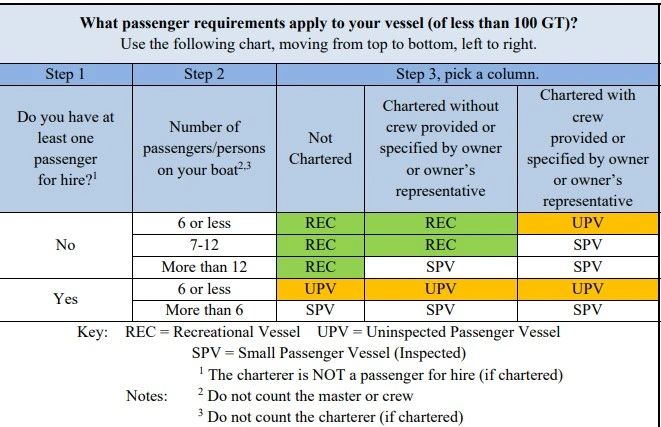
While CWO Lovelace’s passion for safety is undeniable, his presentation was at times difficult to comprehend and intensely technical. Covering a mix of Small Passenger Vessel (SPV) and Uninspected Passenger Vessel (UPV) regulations, much of the nuanced language felt out of reach even for seasoned captains in the room.
The workshop’s primary goal is to help the community, yet that helpfulness is sometimes lost in complex jargon. Future sessions would benefit immensely from simplified language and concrete, “real-world” examples—specifically, the nuances of demise (bareboat) charters. Some attendees departed early, feeling overwhelmed and wondering how they would ever understand Coastwise Trade Laws and MARAD waivers, which may not even apply to their operations.
Closing Remarks
Commander Bigay, who worked tirelessly behind the scenes to bring this event to life, reminded everyone that the ultimate goal is community engagement. The challenge remains reaching new owners who may not realize they are operating illegally. As the 2026 season kicks off, the best advice is to utilize your tax dollars: reach out to the Coast Guard Marine Safety Office in Willowbrook for guidance before you leave the dock. Reach them at (630) 986-2155 or email: MSUChicago@uscg.mil
Thanks
Thanks to the Chicago Shipmasters (represented by President Tom Blakely) and the Chicago Harbor Safety Committee (represented by Secretary John Francis McDermott Jr) for organizing this event. An extra big thanks to Captain Kelli Kovach, a board member of both organizations, who was noted as the “muscle” behind the event. Thank you to everyone from both of these vital organizations!
#ChicagoBoating #BareboatCharter #ChicagoHarbor #MarineSafety #LakeMichiganMariners