
Sub-Total: $0.00
Post
Mastering the Art of the Approach: What is Precision Docking?

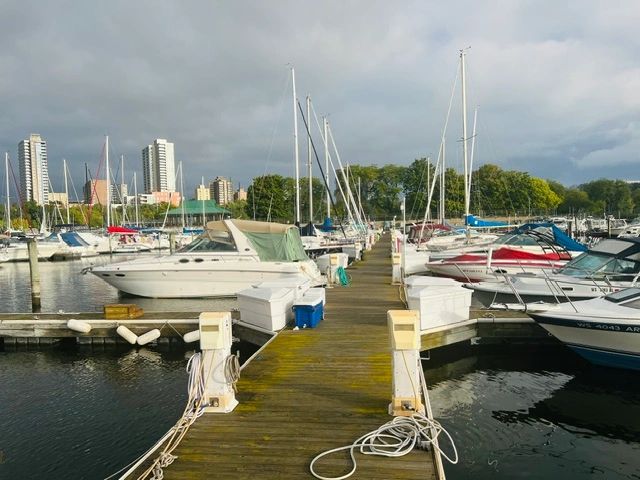
On a sunny late fall afternoon at DuSable Harbor in Chicago, we met with Alex—a boat owner whose name has been changed for privacy. Like many new boaters, Alex initially approached his new vessel with the confidence of someone who had spent decades behind the wheel of a car. “I thought it was like driving a car,” Alex admitted with a laugh. “I didn’t realize how bad I would be at it.”
Alex quickly became infamous at his home harbor. His neighbors would run out of their cabins or off their boats whenever they saw him entering the fairway. They came armed with dock poles, bracing themselves as Alex performed what could only be described as “bumper cars” with his neighbors’ boats. “I was sort of a bad neighbor,” he confessed. “I wanted to get better at boating, and especially at docking.”
Alex’s experience is far from unique. The transition from the solid, friction-heavy world of asphalt to the fluid, shifting environment of the water is a steep learning curve. The solution, however, is not just “more time on the water”—it is formal boat docking training. By enrolling in structured courses, such as the National Safe Boating Council (NSBC) modules on docking and close-quarter maneuvers, Alex transformed from the harbor’s biggest liability into its most precise pilot.
Defining Precision Docking
At its core, precision docking is the ability to maneuver a vessel into a confined space with absolute control, minimal reliance on external help, and zero contact with neighboring structures or boats. It is the antithesis of the “hope and pray” approach often seen at busy marinas.
Precision docking requires the operator to treat the boat not as a land vehicle, but as a vessel subject to the forces of wind, current, and momentum. It involves understanding the boat’s pivot point, how the hull interacts with the water, and how the propeller’s “prop walk” (the sideways force created by the spinning propeller) can be leveraged rather than fought.
When a captain masters precision docking, they are no longer just pointing the bow toward the slip. They are executing a calculated plan that accounts for environmental variables, ensuring the boat arrives at the dock at the exact speed and angle required to secure lines safely.
The Foundation: Close-Quarters Boat Handling
To achieve precision, one must first master close-quarters boat handling. This is the specialized subset of seamanship that deals with maneuvering in tight spaces—such as marinas, fuel docks, and crowded fairways.
Master Captain Brady Ruel, a veteran of both small pontoons and 60-foot commercial vessels, emphasizes that the NSBC curriculum succeeds because it demystifies the mechanics of the vessel. “The NSBC curriculum helps people dock by providing a thorough explanation of how a boat’s engine, wheel, throttle, etc., all dictate how a boat moves through the water,” Ruel explains.
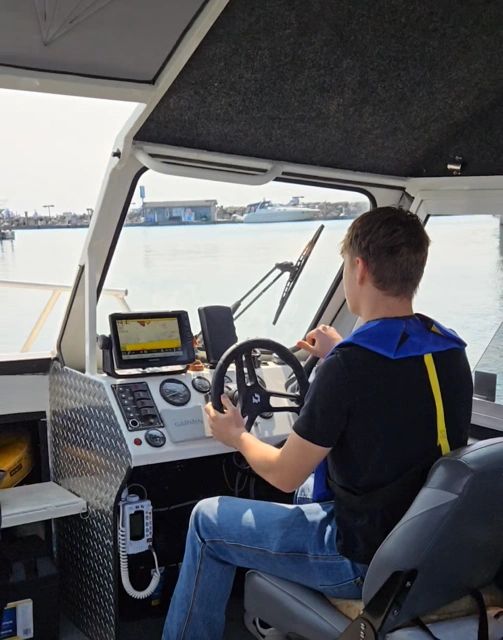
In a car, the steering wheel instantly dictates the direction of travel. On a boat, the steering system often only works when water is moving over the rudder, or the thrust is being vectored by the drive. Close-quarters boat handling requires the captain to understand that the boat is effectively “floating” in a constantly moving medium. This training teaches operators how to use “short bursts” of power to create momentum or pivot the boat without needing large amounts of open water. By learning to use the engines as tools for rotation rather than just speed, a captain gains the ability to “walk” a boat sideways or spin it within its own length.
Working with the Wind
One of the greatest challenges in Chicago, or any harbor, is the wind. A boat is essentially a large sail, even with the sails down. A light breeze can push a lightweight vessel significantly, making a graceful entry into a slip feel like a battle against invisible forces.
“My biggest tip for docking on a windy day in Chicago is always be aware of how the wind is behaving,” says Captain Ruel. “When I come into a harbor in preparation to dock, I will first take note of the direction and speed of the wind. I do this by finding a flag on land or on a docked boat.”
Docking lessons emphasize that you cannot ignore the wind; you must work with it. If the wind is blowing your boat toward the dock, you can use that pressure to your advantage to hold the boat against the pilings while you secure a line. If the wind is blowing you away from the dock, you must approach at a slightly more aggressive angle or speed to maintain control before the wind pushes you off-course. By observing the environment—flags, ripples on the water, and the movement of other boats—a captain can formulate a plan that uses the wind as an assistant rather than an adversary.
The Strategy of Approaching Slips
The approach is the most critical phase of the docking process. A bad approach cannot be saved by a good landing. Precision docking training teaches captains to break the approach into a step-by-step sequence:
- The Assessment: Before entering the fairway, observe the wind, current, and the layout of the slip.
- The Alignment: Ensure the boat is positioned to enter the slip with enough room to correct the angle.
- The Speed: Always take it slow in and around the harbors. Momentum is your enemy in close quarters; you can always add more power, but you cannot easily subtract it once you have committed to a slip.
- The Commit: Once the bow enters the slip, focus on the pivot point and use the helm and throttle to keep the boat centered.
By simplifying these steps, the “magical” nature of docking lessons becomes clear. It isn’t magic; it is a methodical, predictable process that removes the panic from the experience.
Communication: The Captain and the Crew
A boat is only as good as the team operating it. One of the biggest mistakes in docking is poor communication between the captain and the deck crew.
Precision docking relies on a shared understanding of roles. The captain must communicate the plan: “We are going to come in on the starboard side. I need you to have the midship line ready, but do not jump onto the dock until I signal.”
Crucially, boat docking training teaches that the deck crew should never be a “fender.” A common bad habit is for crew members to try to push the boat off the dock with their hands or legs. This is dangerous and ineffective. Professional training emphasizes that the lines are the tools for stopping the boat, and the captain’s throttle and wheel are the tools for positioning it. The crew’s job is to secure the boat, not to catch it.
Practice Outcomes: From “Bumper Cars” to Perfection
The result of this training is a profound change in the operator’s confidence and competence. For Alex, the turnaround was nearly instantaneous. After completing his training, he returned to DuSable Harbor. As he navigated the fairway, his neighbors once again ran out, expecting the usual chaos. Instead, jaws dropped.
Alex maneuvered his boat into the slip with grace and precision, stopping exactly where he intended without a single bump. “Alex, how the heck did you do that?” a neighbor shouted. His answer was simple: “I took a class!”
The outcomes of these docking lessons extend far beyond the ego boost of a perfect landing:
- Safety: You protect your investment, your boat, and others’ property.
- Reduced Stress: Docking is no longer a source of anxiety; it has become a satisfying skill to perform.
- Increased Enjoyment: When you aren’t afraid of the harbor, you are more likely to take your boat out and use it.
- Longevity: “It’s important to continue learning and practicing your boating skills,” says Captain Ruel. “I started on a 20-foot pontoon as a child… and for the past several years, I’ve been captaining 40- 60 ft private boats, but I still go back to the pontoon.”
Whether you are a novice like Alex or an experienced sailor looking to sharpen your maneuvers, professional instruction provides the mental framework and physical technique necessary to operate your vessel with confidence. Boat handling is a lifelong journey, and every hour spent in formal training pays dividends in the form of safer, more enjoyable days on the water.
.jpg/:/cr=t:0%25,l:0%25,w:100%25,h:100%25/rs=w:1280 "Boat Safe Chicago's National Safe Boating Council Course Training Flyer/courtesy of Boat Safe Chicago training modules introduction to power baoting powerboating docking and close quarter maneuvers open water advanced open water boat training")
Ready to master the helm? View our full schedule of docking courses in Chicagoland, Indiana, Southeast Wisconsin, and Michigan today. Have questions? Send a note to Dani@BoatSafeChicago.com and let’s get you on the water.
#boatdocking #boathandling #dockinglessons #marinalife #boatingeducation #sailing #powerboating #safetyatsea #marinelearning